What We Do

At Women in Development and Advocacy (WIDA) Ghana, our work is centred on connection, capacity, influence, and impact. We move beyond networking to create meaningful platforms that strengthen women’s leadership and shape development outcomes.

Programmes for impact

A close-up of an elegant dark wood bookshelf, its shelves impeccably arranged with development and policy books, each spine in rich jewel tones of deep blue, burgundy, and forest green. Interspersed between the books are small symbolic objects: a finely carved Adinkra symbol in bronze, a miniature globe highlighting Africa, and a simple framed document labeled “Policy Brief” with highlighted sections visible. Soft, indirect studio lighting washes over the shelves, creating a warm, dignified glow and gentle shadows between volumes. Photographic realism with a slightly angled composition emphasizes depth and order. The mood is intellectual, grounded, and aspirational, reflecting a commitment to knowledge, advocacy, and long-term impact in Ghanaian society.

Mentorship: pair emerging leaders with seasoned professionals to build confidence, share, and accelerate projects.
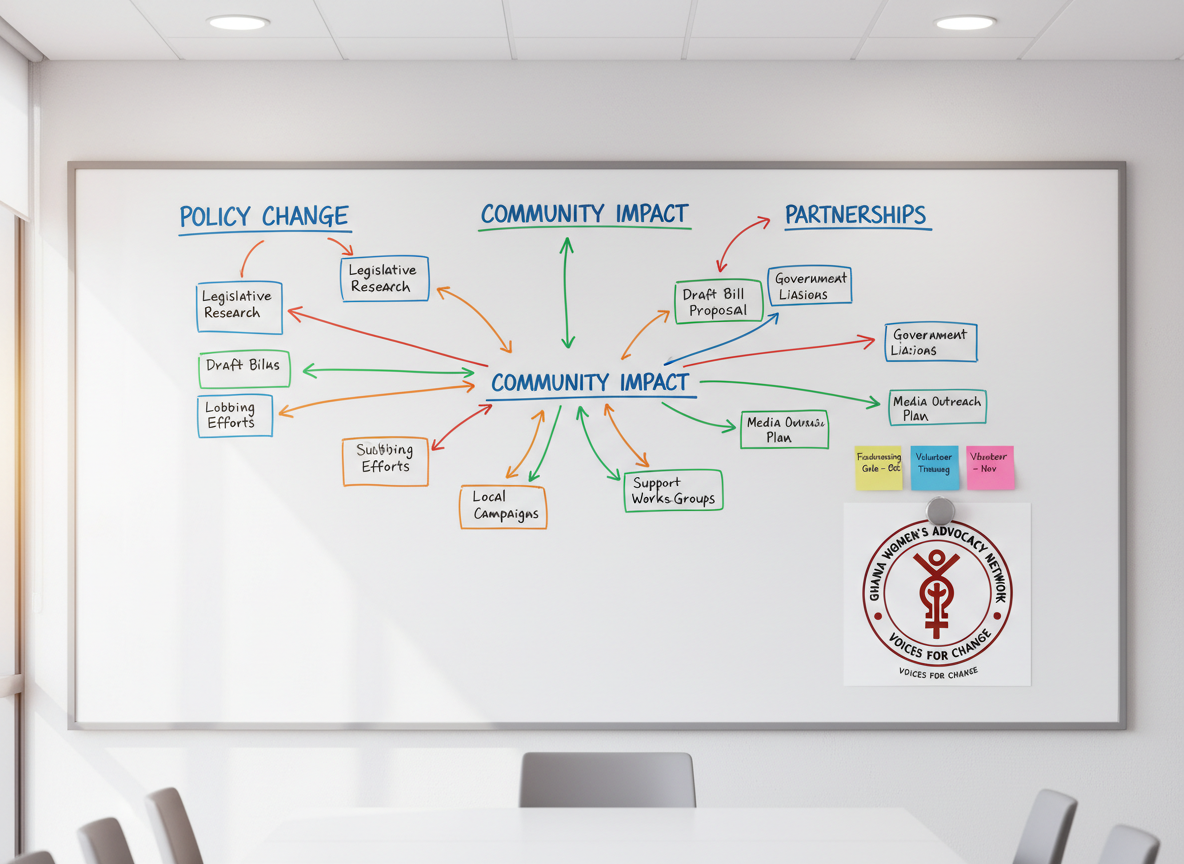
A sleek whiteboard spanning a clean office wall, filled with a thoughtfully organized advocacy strategy diagram in vivid markers: clear headings like “Policy Change,” “Community Impact,” and “Partnerships,” with connecting arrows and boxed milestones. At the bottom corner, a printed logo mockup for a Ghana-focused women’s advocacy network is magnetically pinned alongside color-coded sticky notes. The room is lit by bright yet soft overhead lighting, complemented by natural daylight filtering from the side, eliminating harsh shadows. Shot straight-on in photographic realism with sharp focus across the board, the composition uses the rule of thirds to highlight key strategy points. The atmosphere is energetic yet professional, evoking structured planning, clarity of purpose, and coordinated action for social impact.

Advocacy Training: practical sessions on messaging, policy analysis, and stakeholder engagement to influence outcomes.

Convene & Connect

We create intentional spaces for professional women to meet, engage, and collaborate across sectors. Through networking forums, roundtables, learning sessions, and strategic dialogues, we foster partnerships that spark innovation and collective action.

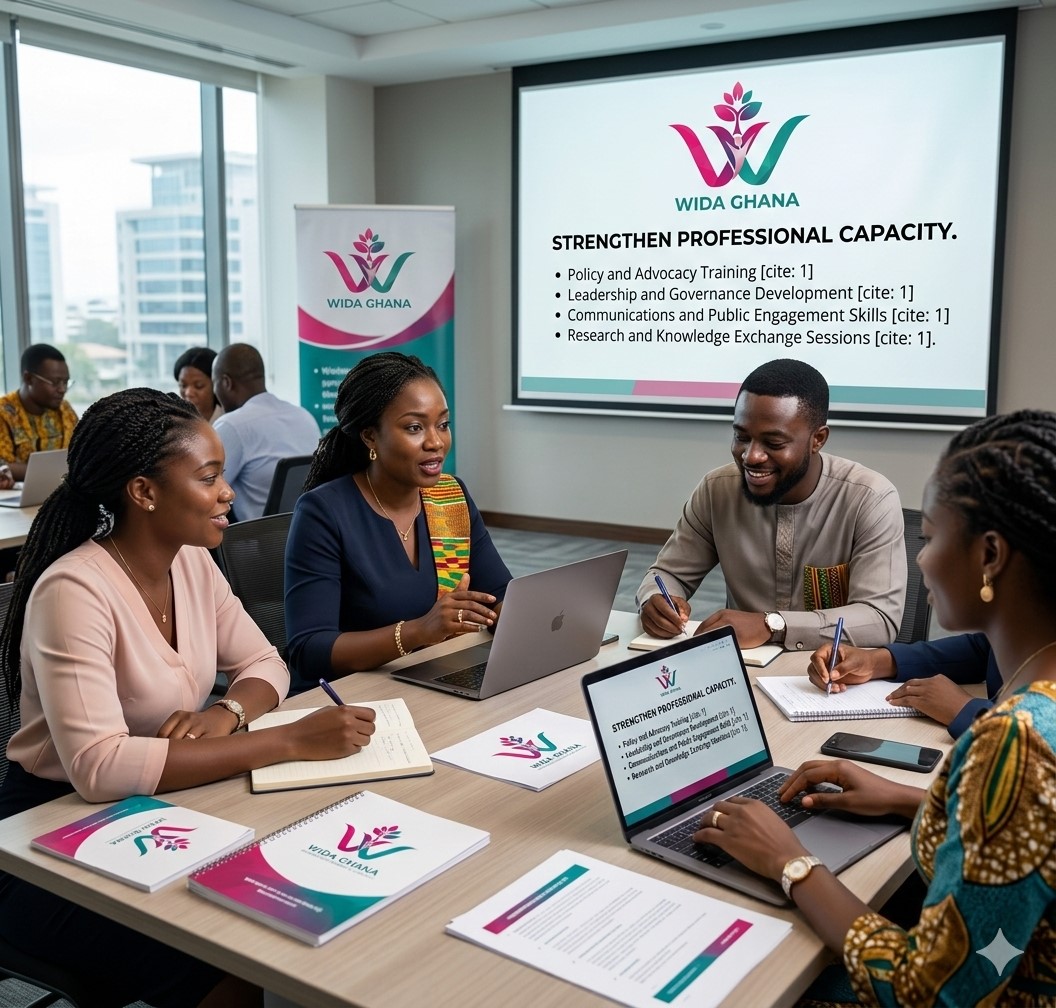
Strengthen Professional Capacity

We equip our members with the knowledge, skills, and tools needed to excel and lead effectively. Our capacity-building initiatives include:

Research and knowledge exchange sessions

Policy and advocacy training

Leadership and governance development

Communications and public engagement skills

Influence Policy & Systems

WIDA Ghana provides a platform for women’s voices to be heard in policy and decision-making spaces. We:

Engage institutions and stakeholders to drive inclusive reform.

Facilitate evidence-informed policy discussions

Promote gender-responsive approaches to development

Support advocacy initiatives that address structural inequalities

Amplify Visibility & Voice

We actively highlight the work, expertise, and impact of women professionals. By showcasing thought leadership, publishing insights, and creating speaking and media opportunities, we ensure women are visible contributors to national and global development conversations.

Foster Collaboration & Collective Action

We encourage joint initiatives among members and institutional partners. Whether through research collaborations, community interventions, or policy campaigns, WIDA Ghana promotes collective solutions to complex development challenges..

Mentor & Support Emerging Leaders

We are intentional about intergenerational leadership. By connecting experienced professionals with emerging practitioners, we nurture confidence, competence, and long-term leadership growth.

Through these actions, WIDA Ghana strengthens women’s influence across development, governance, advocacy, and social impact, ensuring that women are not only participants in change but also architects of it.

Outcomes through actions

A simple theory-of-change connects our activities—mentorship, training, dialogue, and outreach—with measurable improvements in women’s leadership, policy influence, and community well‑being across Ghana.

A beautifully arranged meeting space featuring a long rectangular table of smooth light oak, meticulously set with identical navy-blue folders labeled “Policy Dialogue,” each accompanied by a fine-point pen and a glass bottle of water with condensation. At the far end of the table, a large screen displays a blurred presentation slide with charts and the outline of Ghana. Floor-to-ceiling windows on one side let in bright but diffused daylight, softly illuminating the room and casting faint shadows of the chairs on the polished floor. Photographic realism, captured from one end of the table with a strong sense of depth leading toward the screen. The mood is formal, structured, and optimistic, ideal for high-level discussions on development and advocacy outcomes.
A modern glass-topped desk with a matte black metal frame, positioned near a large window overlooking a soft-focus cityscape of Accra at dusk. On the desk sits a detailed printed map of Ghana with regional markers, a leather-bound planner open to a neatly organized advocacy schedule, and a tablet showing a dashboard of development indicators. A small kente-patterned notebook adds a distinct Ghanaian touch. Warm golden-hour light spills across the desk surface, creating gentle shadows and highlighting the textures of paper, glass, and fabric. Captured from a slightly elevated angle in photographic realism, the scene feels purposeful, organized, and aspirational, with clean, modern lines and a subtle sense of momentum toward positive social change.
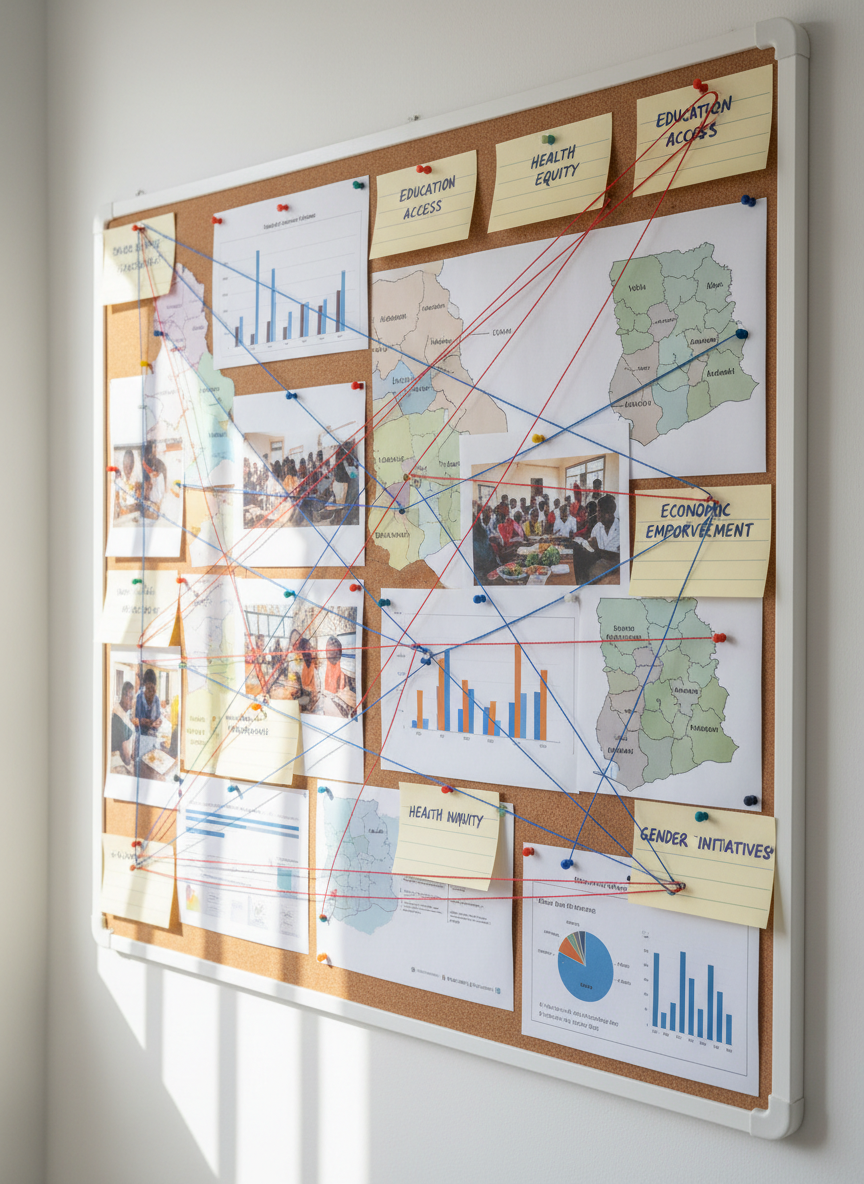
A close, detailed shot of a corkboard mounted on a clean white wall, meticulously covered with development project photos, printed data charts, and pinned index cards labeled with themes like “Education Access,” “Health Equity,” and “Economic Empowerment.” Thin red and blue strings connect certain cards to maps of Ghana’s regions, creating a visual network of impact. Natural daylight from a nearby window falls diagonally across the board, accentuating pushpin heads and paper edges while leaving parts in gentle shadow. Captured in photographic realism from a slight side angle, the depth of field keeps all elements sharp. The atmosphere is analytical and mission-driven, showcasing organized thinking and the interconnected nature of social change work in Ghana.